Boredom is the biggest enemy of every martial arts
teacher - your students' boredom and your own. Teaching classes every
day, year after year can become monotonous quickly if you are not constantly
searching for new teaching ideas, drills, games, exercises and techniques.
Not only will your students be bored doing the same old drills, you
will be bored teaching them over and over. To maintain an excited, active
student body and keep yourself excited about teaching, you need a ready
source of ideas and brain ticklers.
This section is meant to be just that. A resource
that you can turn to while you are developing your lesson plans or just
before you head out of the office to start a class. A quick reference
guide packed with new ideas as well ideas you might have long forgotten
or that may lead you to create your own games and drills.
Below are a few ideas excerpted from this section of Martial Arts Instructor's Desk Reference:
Obstacle courses
Making an obstacle course in the training hall is
a great class starter for kids' classes. Don't let anyone stand around
waiting in line - assign a time killing exercise like jumping jacks
or running place between turns at a station. Some ideas for stations
to keep everyone moving:
- Jump over a pile of kicking shields
- Crawl through a tunnel of kicking shields without
touching them
- Jump over a series of heavy bags laid about two
feet apart
- Kick or strike a hanging target, hanging bag or
stand up heavy bag
- Weave around a line of hand targets
- Duck walk under a hanging heavy bag
- Look in the mirror and kihap loudly five times
- Roll between two kicking shields without touching
them
- Block an " attack " by a blocker or
foam wand
- Kick a paper cup off of the top of a standing
bag
- Crawl under a stick balanced on two chairs
- Walk on a line on the floor (masking tape works
well and removes easily after use)
- Hop over a belt laid on the floor to form a zig-zag
course
Some stations may require an adult to reset or facilitate.

Whistle Drill
A more advanced variation of Simon Says is the whistle
drill. The students spread out on the floor and you gives a command
like " jumping jacks " and blows a whistle. The students do
jumping jacks until the instructor blows the whistle again. The students
then must freeze and not move. Then give another command and blow the
whistle to signal the students to begin. Any student who moves between
whistles is out and has to sit down. You may also try to trick students
into moving by calling a technique, but not blowing the whistle. Any
student who does the technique is out. For really tough students, you
can talk to them, approach them, ask questions and try to distract them
into to moving.
Random Attack and Defense
Students love to try out their self-defense skills
in a realistic scenario. With group of intermediate or advanced students,
have the students form a line (one behind the next) in front of you.
As each student comes to the head of the line, throw an attack (for
which they have learned a defense) at them quickly. Each student has
a few seconds to react. Whether they successfully defend or not, their
turn should end in less than 10 seconds and they return to the end of
the line. Keep moving quickly and vary your attacks. This drill has
many variations, some of them can get quite rough if you are not careful.
Keep a tight reign on safety rules and have students wear protection
gear if you think it is necessary.
Circle: Form a circle with one person in the
middle as the defender and those forming the circle as attackers. Go
around the circle and have each attacker enter the circle and attack
the defender with an approved technique. (one that the defender has
learned)
Numbered circle: Form a circle as above and
give each person in the circle number. When you call out a number, that
person should run into the circle and attack as above.
Advanced numbered circle: Call out two or
three numbers at once so the defender has to cope with multiple attackers.
Anything goes circle: For advanced students,
you can allow any type of attack (within safety precautions) and the
defender has to defend drawing upon his or her knowledge, but not necessarily
using a preformulated defense technique.
Timed circle: Call out a number and that person
can play attacker for thirty seconds or one minute, launching a series
of attacks against which the defender must defend.
Payback circle: Play any of the circle games
above, but allow the defender to throw and attack at any one person
on the outside of the circle when you call " payback ".
Sparring matches
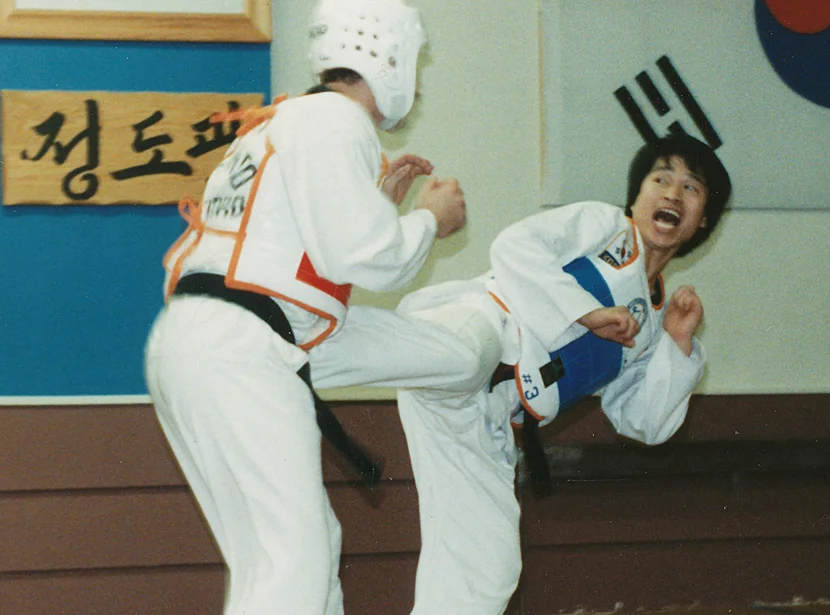
Most schools have students face other for practice
sparring. However, sparring with feedback can be more fun, not to mention
very helpful in improving competition skills. Some fun ways to stage
matches in class:
First point: Select two evenly matched students
to face each other. At your command, they begin sparring. The first
student to score a point continues on against another opponent and the
loser sits down.
Challenge sparring. Two students face off
for a short match in any format you choose. After the match, the loser
sits down and the winner " challenges " any other student
in the class.
Rotating matches. This drill is more suited
to children than adults. Have a group of about ten kids face off in
pairs and begin non-contact sparring on your command. Watch the group
and call any points you see (" Jimmy, one point ") as they
are scored. You won't see everyone score every point, but try to catch
each kid at least once. The kids will really work to get your attention.
After a couple of minutes, have the group sit down to rest and call
a new group.
Point tag. To practice speed and concentration
rather than techniques, have a game of point tag. Give the students
a goal like tagging the other persons left shoulder or belt knot. Each
student has to protect his own target while trying to tag the other
student's target area. Once a student is tagged, the match is over.
Counter sparring. Give points only for counterattacks. Each student takes turns initiating an attack for the other student to counter. Only successfully countered attacks score points.
Combination sparring. To develop combinations, give points only for the second, third or fourth technique in a combination.
The above article is copyrighted by the
author. All rights reserved.