

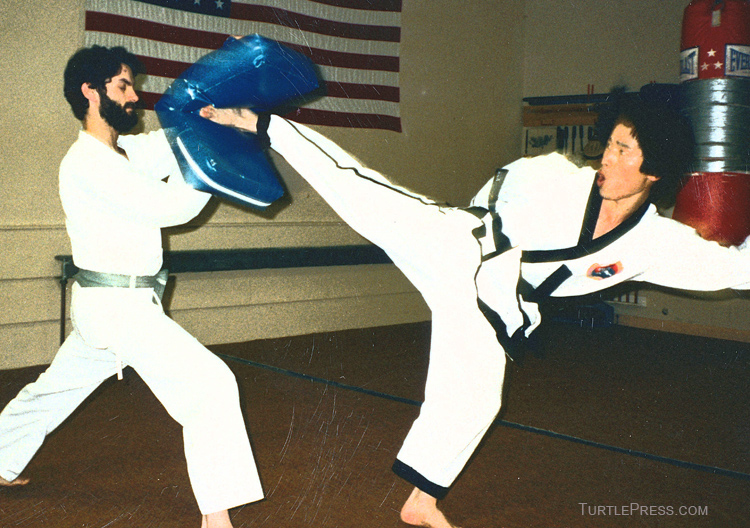
Excerpted from Martial Arts After 40 by Sang H. Kim
Here are some training tips to keep in mind when developing speed in your skills:
1. The skill must be conducive to speed training.
Most martial arts skills can be done at full speed, either in the air, with a partner or against a target. Gross motor skills are more easily adapted for speed training than precision skills.
2. The skill must be physically sound.
Do not try to build speed until you have mastered the basic physical model of a skill. If you have to think about the mechanics of performing a skill or you are performing it without the correct biomechanical form, your potential for speed development is limited.

3. Relax.
Speed training requires relaxation from the point of initiation up to the point of impact. At the point of impact, the muscles should briefly tense and then relax again to facilitate quick recovery.
4. Recover.
Recovery between executions is essential for improving speed. If you are training a single skill, like front kick, the recovery between kicks can be brief, up to fifteen seconds. If you are working on combinations, spend a bit more time between repetitions so you do not become fatigued too early.
5. Practice first, practice last.
There are two theories on where in your workout speed training should come. Many experts advise putting speed training early in the workout so you are not fatigued and your muscles are fresh. This is good advice if you are relatively flexible, have good muscular endurance and can relax easily. There are two drawbacks to doing speed training early in a workout: you can become too fatigued to perform well later in the workout and you may be too tense to fully achieve your potential. Practicing speed skills near the end of a workout means your muscles are looser and therefore you may find it easier to relax although you may sacrifice some freshness. Arrange your speed training to suit your performance style.
6. Use low repetitions.
Keep the number of repetitions of each skill low (less than 10) but the quality of each repetition very high. Perform each rep with complete concentration and fully rest between repetitions.
7. Feel the speed.
As you perform each repetition, you may find that a particularly fast repetition “feels” different from all the others. Try to capture and recreate this feeling, whether it is a feeling of lightness, relaxation, energy, intensity or whatever name you assign to it.
8. Take time off.
As you practice for speed, you may find that you have hit a speed bump, a pace which you can consistently imitate, but cannot break through. When this happens, it’s time to take a few days to a week off from speed training. Instead of practicing the technique, spend time each day visualizing breaking through the speed bump.