


Excerpted from Combat Strategy by "Hanho" *(Sang H. Kim)
Combinations can be classified by the force that they apply. Force classifications are defined by the direction in which they apply force to the opponent. Consequently, they are often more difficult to identify than directional classifications. Force is an internal characteristic that is not readily evident to an observer. It can be obvious, as in unified force or deceptive as in opposing force.
Unified force combinations
Unified force combinations are groups of skills that apply continuous force in a single direction. Every strike serves to magnify the effect of the previous one. Strikes can be the same such as a flurry of punches to the body or they can be diverse like a variety of linear and circular kicks aimed at the legs of the opponent.

Unified force combines high-low-middle approaches to linear and circular attacks with all parts of the body. The only qualifying factor is that every blow will deliver its force in the same direction as the previous one. This serves to punish the opponent in one area and wear him down. Unified force combinations are effective in prolonged combat because they provide a greater effect over time. Some examples of unified force combinations are:
- Throwing by gripping the opponent's shoulders and pulling to the right with your right hand and pushing to the right with your left hand
- Right backfist to the head and left knife strike to the neck followed by right palm strike to the chin (LS)
- Left backfist to the face and right hook kick to the knee followed by right back fist to the face (RS)
Circular force combinations
Circular force combinations are combinations that apply force that rotates around an axis. The axis is located at a point on your body, as close to your center of gravity as possible. The force is then directed to the target by two terminal points on your body, usually your hands or feet. The resulting effect is the magnification of both applications of force.
The first application of force, whether by striking or grappling, will always intensify the second. In striking, the second strike is intensified by the centripetal force generated by the first. For example, a backfist to the face, followed by a hook kick to the leg and a back kick to the groin will create a continuous 360 degree circle with one technique leading directly into and intensifying the next.
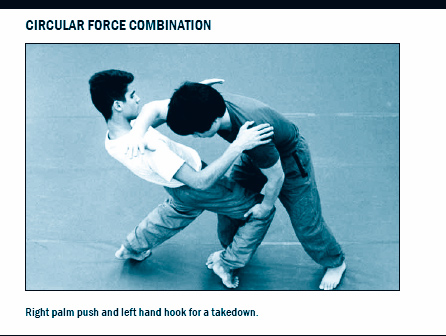
So, in striking, one movement follows the other in smooth and complementary progression. In grappling, however, the theory is altered slightly. When applying a throwing or locking skill, the circular force will occur concurrently, with each force simultaneously intensifying the other. An example is a hip throw where the upper body pulls the opponent forward and downward and the hips and legs push to the rear and upward. Performing these movements in succession will not produce the desired results. They must be done simultaneously with a sensitivity to the circular force being created. Some examples of circular force combinations are:
- Left hand pushing the chin and right hand hooking the rear knee for a takedown
- Hip throw (upper body pulling and lower body pushing)
- Left hook kick and right back kick
Opposing force combinations
Opposing force combinations are pairs of skills that apply force in antagonistic directions. They consist of at least two distinct movements that work in opposition to each other yet are complementary. They often look similar to circular force combinations but there is a conspicuous distinction. Circular force skills can be traced to a single line of movement around one axis. Opposing force skills move in intersecting lines or arcs. (fig. 3.8)
Like circular combinations, opposing force combinations can be studied in terms of striking skills and grappling skills. Opposing force strikes are often used to set each other up. An example is a left hook to the head followed by a right hook to the head. The left hook will start the opponent's head moving to the right. When you follow with the right hook, the force created by the left hook, combined with the weight of your opponent, will crash into the force of your right hook, to increase the damage done. By using the left hook as a set-up, you intensify the effect of the main technique, the right hook.

In grappling, you also can use an antecedent technique to set up the main technique. For example, by pulling your opponent to the left you cause him to resist in the opposite direction, to the right. When he has firmly set his center of gravity to the right, change your tactics and take him down to the right. Use his resistance against him and reduce the amount of effort necessary to defeat him.
To summarize, in striking, increase the force of the second technique by preceding it with an opposing force strike. In grappling, apply force in one direction, then reverse the direction of the force and use your opponent's resistance against him.
Some examples of opposing force are:
- Left hook punch to the jaw and right hook punch followed by left uppercut to the jaw. (RS)
- Wrist lock to the right and right front kick to the face of opponent followed by an arm pin on the ground (RS)
- Twisting wrist lock to the right followed by reverse twisting wrist lock to the left
Combining Force and Directional Principles
Every combination can be defined by both force and direction. It may not always be obvious at first, but careful study will reveal which category the skills fit into. Here are some examples of combinations from each force/direction category:
- Lateral unified: Right hook kick to the thigh and right elbow hook to the face
- Lateral circular: Left whipping tiger claw to the face and left outside takedown
- Lateral opposing: Right hook to the head and left hook to the head
- Planar unified: Right pushing front kick to the thigh, left side kick to the body and right straight punch to the face
- Planar circular: Right chin push and left hand hook the knee for a takedown
- Planar opposing: Left grab hand grab behind the neck and right elbow uppercut and pull head down into right vertical knee strike
These are the basic theories behind the secondary response. In upcoming sections of Book 3 and Book 4, you will learn about the strategic nuances of the secondary response in more depth