
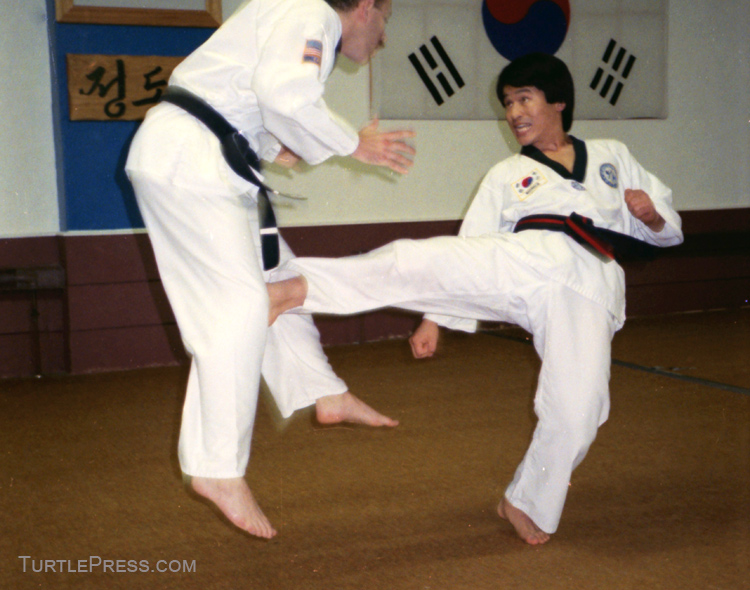
I am a lifetime marital artist and former combat
instructor in Special Forces. I have developed, written and taught combat
and self defense courses around the world to more than 100,000 students
and instructors. Even after more than 35 years of experience in martial
arts training and combat survival experiences, every time I enter an
unknown environment, I always question myself on "What if
"
No matter how experienced you are in the martial
arts or how confident you feel in defending yourself, awareness is a
far more powerful weapon than any other you practice in the training
hall. Don't be an easy prey. Watch for signs that signal danger during
the following stages of interacting with a potential assailant:
Stage #1: Approaching
Approaching is the first sign of potential danger.
An assailant may walk toward you casually, follow you from behind or
jump out of nowhere. This is the time for you to prepare for avoiding
the assailant or running away.
Remember: Don't Run Away from Danger; Run to
Safety. You don't need to beat or defeat an assailant - there
are no winners in self-defense. Your only goal is to escape safely.
Stage #2: Closing
If you feel even slightly uncomfortable about a person
approaching you, do not allow the assailant to get closer than 5-6 feet.
If necessary, give a stern verbal warning such as "Stop there"
or "Don't come any closer."
Stage #3: Trapping
An assailant intent on harming you, will ignore a
verbal warning and continue toward you. At this point, there is no doubt
about the assailant's intent and this is your cue to flee immediately
and without hesitation. Be aware that if you begin to flee, an assailant
may try to drive you to a confined area.
Stage #4: Attack
When physically attacked, there are a number of things
to keep in mind that might mean the difference between life and death.
The most important lesson that I learned in military combat is the power
of the mind. Stay calm and alert. Don't Panic. An experienced
assailant will use your mind against you, taking advantage of your panicked
state to control the situation.
The second lesson is that everybody makes mistakes.
Look for Mistakes. Even the most overwhelming assailant, no matter
how indestructible he appears, can make a mistake. That's when you will
find an opening to break though.
The third lesson is that every physical confrontation
is fluid and the changing nature of the conflict will create a number
of opportunities for you to escape or counterattack. A physical assault
has a goal. An assailant wants something from you, whether to injure,
rape, rob or kill. Until he obtains his objective he will continuously
progress toward his goal. This means that the situation will continue
to change as the assailant progresses toward his goal.
Think ahead: Sometimes waiting can be better
than acting immediately if you think the changing situation will give
you a better option. Try to figure out what the attacker needs to victimize
or dominate you (i.e. Space to attack, a free hand to assault you) and
don't let him have it.
Example: You are pinned on your side (lateral cobra
twist) by a rapist and cannot escape, don't panic. A rapist cannot achieve
his goal from this position. At some point, he will have to change position.
When he loosens his grip, shifts his weight or tries to gain a better
position for his legs, his momentary distraction provides you a chance
to escape or counterattack.
The fourth lesson is don't dwell on your mistakes.
Move on. Quickly. We all make mistakes but they are just a part
of the whole process. Keep your sight on the entire spectrum, which
is your survival. If a technique is not working as expected it, don't
fight it. Change your plan, look for a better opening, move in the opposite
direction or use a distraction technique.
The final lesson that I learned through experience
is that you need to have a plan. Before you enter any unfamiliar circumstance,
take a moment to size up the environment and to practice an Emergency
Mental Rehearsal. Know how to protect your body. Know where to strike.
Know where to look for help.
In any violent situation, you just never know what
is going to happen and where the situation will take you. You never
know when you have to get extremely violent and when to choose life
and death decision. By mentally rehearsing how far you are willing to
go in defending yourself and what types of defensive tactics are available
to you in a given environment, you gain a powerful added weapon: a plan
of defense.
Stage #5: Aftermath
In the aftermath of an attack, such as a mugging
or assault, the assailant may decide to kill the victim. Do not let
down your guard until you have escaped to safety or the assailant has
completely left the area.
Practicing self-defense scenarios, both in your mind
(visualization) and with a partner, is essential. Rehearsing situations
helps you think through how you might handle a potential threat.
The above article is copyrighted by the
author. All rights reserved.